CFTE
Global SME Finance Forum 2026, 18 to 20 November, Singapore
Singapore FinTech Festival 2026

Build Your Small Business Growth Enablement Action Plan

Senior leaders from banking, asset management, regulation and policy met under the Chatham House Rule to separate where AI is creating value now from what agentic systems will require next. The full report is now available.

Date
Friday 20 November 2026, plus a panel on Thursday 19 November
Time
Closed-door roundtable
Format
In-person training (20 Nov) and panel (19 Nov)
Venue
Standard Chartered, Singapore

CFTE | Roundtable report

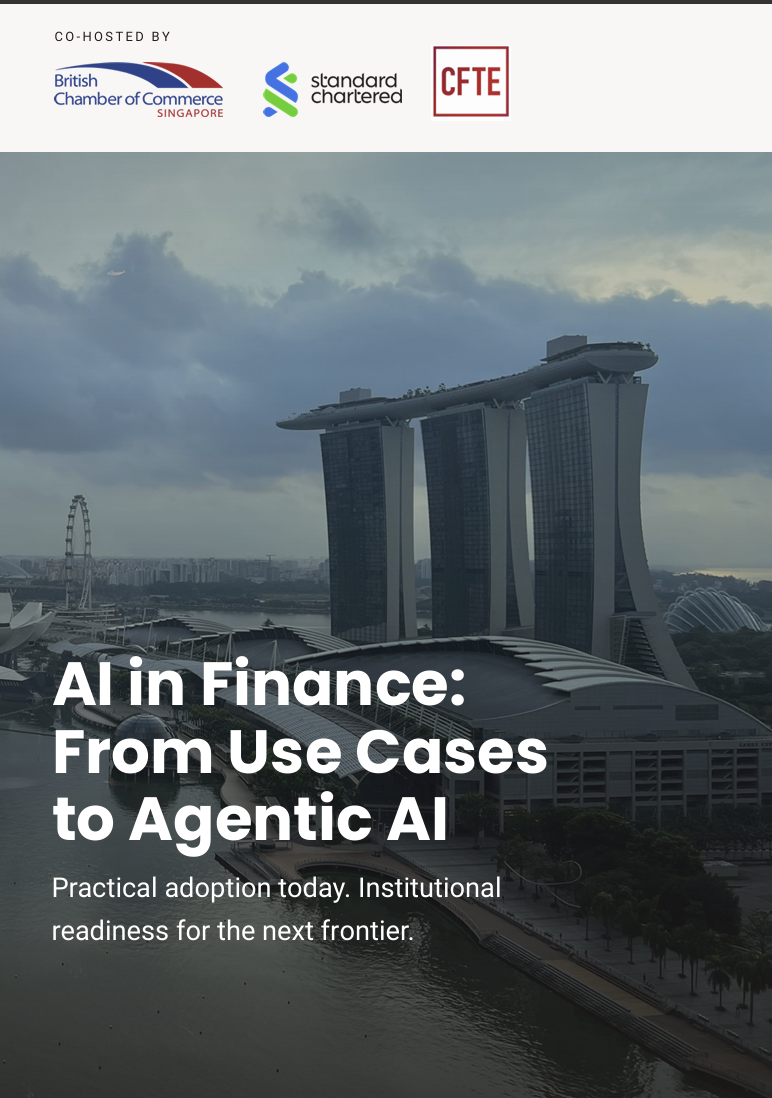
AI in Finance: From Use Cases to Agentic AI

AI in Finance: From Use Cases to Agentic AI

Friday 20 November 2026
·
Closed-door roundtable

Artificial intelligence is rapidly moving from experimentation to real-world deployment across financial services. The next phase of AI in finance may be defined not simply by more powerful models or smarter copilots, but by the rise of agentic systems: AI that can plan, execute multi-step tasks, interact with tools, coordinate workflows, and escalate decisions to humans when appropriate.

For financial institutions, this shift opens significant new opportunities for efficiency, innovation, and customer value while also introducing new questions around governance, control, accountability, and risk.

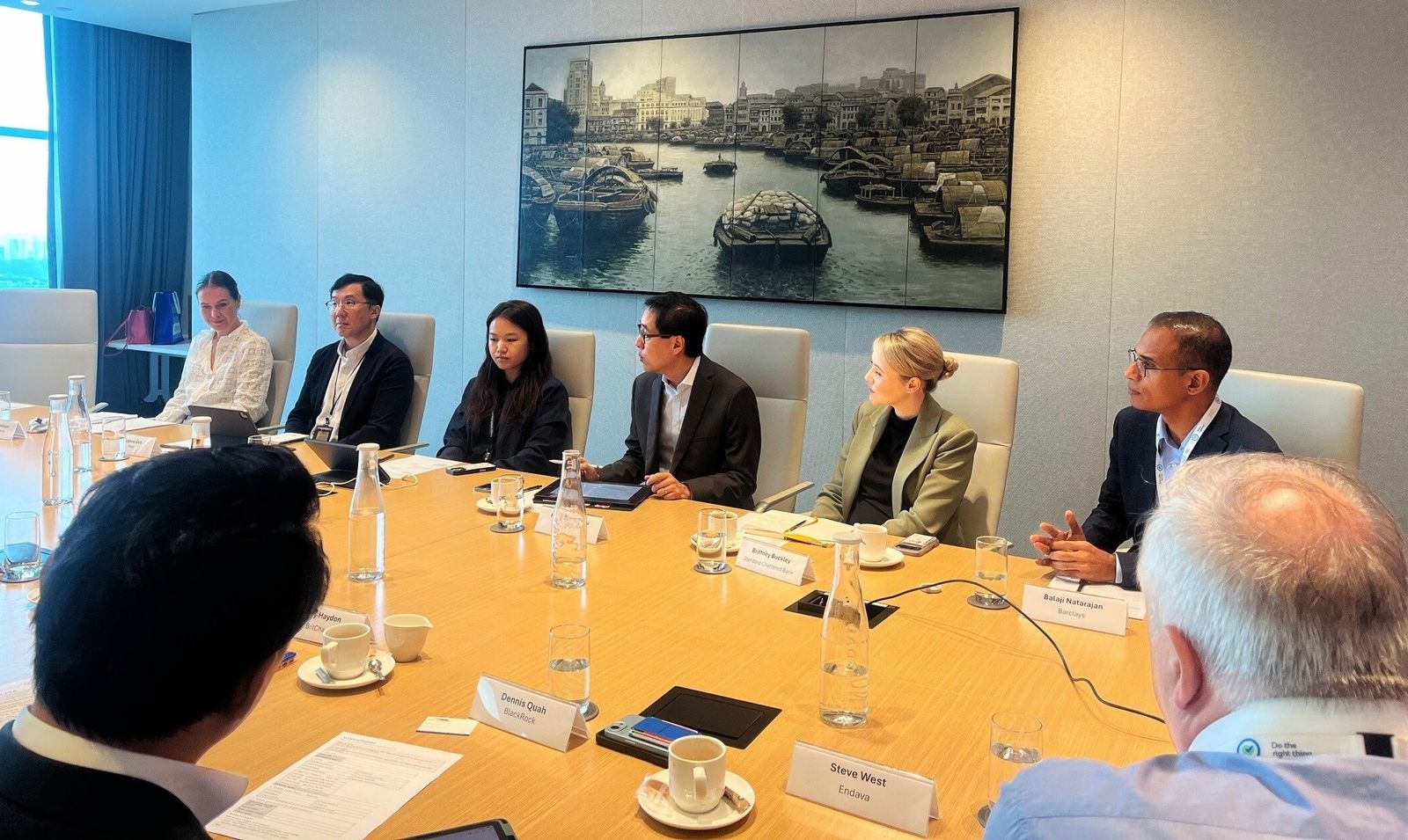
This roundtable brought together senior leaders to explore where AI is already delivering tangible value, and how the emergence of agentic AI could reshape the industry in the years ahead.

Core framing

Current use cases show where AI is creating value today; agentic AI raises the next set of questions about workflow, control and institutional readiness.

Session speakers

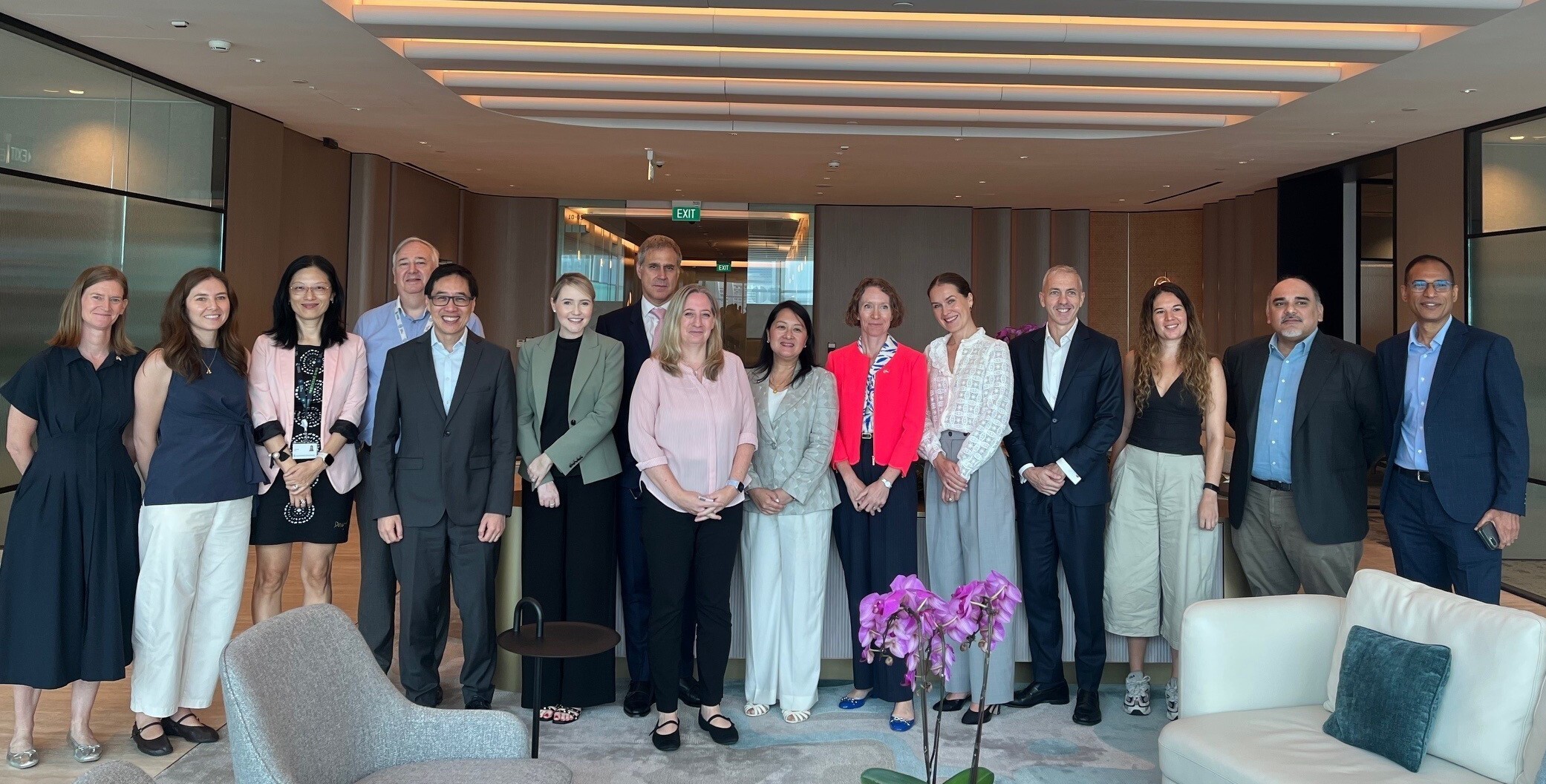
Who was in the room

Tram Anh Nguyen
Co-chair
Tram Anh Nguyen
Co-Chair, Finance and Fintech Committee, British Chamber of Commerce Singapore.
Co-Founder, CFTE.
David Sharratt
Co-chair
David Sharratt
Co-Chair, Finance and Fintech Committee, British Chamber of Commerce Singapore
Managing Director, Corporate and Institutional Banking, Standard Chartered

Lucy Hughes
Opening keynote
Lucy Hughes
Deputy British High Commissioner to Singapore

At the table

Lucy Haydon
Lucy Haydon
Deputy Executive Director
British Chamber of Commerce Singapore
Huy Nguyen Trieu
Huy Nguyen Trieu
Co-Founder
CFTE
Brittney Buckley
Brittney Buckley
Head of Business Transformation, Corporate and Investment Banking
Standard Chartered
Shayan Hazir
Shayan Hazir
Managing Director, Chief Digital Officer, Asia, HK and MENAT
HSBC
Ian Macdonald
Ian Macdonald
CEO APAC
Aberdeen PLC
Tina Berg-Neilsen
Tina Berg-Neilsen
Vice President, Digital Capital Markets
NatWest
Dennis Quah
Dennis Quah
Managing Director
BlackRock
Steve West
Steve West
Head of Asia
Endava
Balaji Natarajan
Balaji Natarajan
Regional Head of Product and Channels, APAC and Middle East, GTB
Barclays

Observers
Megan Otway
Megan Otway
FCA Financial Services Attache
British High Commission Singapore
Eugene Goh
Eugene Goh
Deputy Director, Financial Infrastructure and AI
Monetary Authority of Singapore
Vivian Fang
Vivian Fang
Associate, Financial Infrastructure and AI
Monetary Authority of Singapore
Amy Ross
Amy Ross
Head of Financial, Professional and Business Services, APAC
British High Commission Singapore
Catriona Lindsey-Renton
Head of Financial Policy
British High Commission Singapore
Monica Chen
Monica Chen
Executive Director, Corporate and Investment Banking
Standard Chartered
Paridhi Agarwal
Paridhi Agarwal
Graduate Analyst
CFTE
Global SME Finance Forum session banner: What Makes SMEs Grow? Skills, Services and Technology Adoption, with Tram Anh Nguyen of CFTE among the speakers

What Makes SMEs Grow? Skills, Services and Technology Adoption

Thursday 19 November 2026
·
13:20 to 14:00 SGT

SME productivity challenges often come down to management capacity and workforce skills as much as to finance or technology. This session explores how talent, management skills and embedded support services can be built into SME financing models, and which institutional changes would make bundled financial and non-financial services viable at scale.

Tram Anh Nguyen, CFTE Co-Founder, joins the panel, moderated by Carissa Reiniger of Silver Lining. Forum Stage, Peridot 202-203, Level 2, Singapore EXPO. Open to Forum participants.

Session speakers

Farhat Sarsekeyev
Chief Executive Officer
DAMU - Entrepreneurship Development Fund
Natalie Madeira Cofield
President and Chief Executive Officer
Association for Enterprise Opportunity (AEO)
Tram Anh Nguyen
Co-Founder; Chairwoman
CFTE; Global Women in AI
Dr. Monika Paulė
Chief Executive Officer
Innovation Agency Lithuania
Carissa Reiniger (moderator)
Chief Executive Officer
Silver Lining
Identify where AI is creating real value in financial services today
Participants share practical examples of AI use cases across banking, asset management and related areas of financial services, including what is working, what remains difficult and what separates serious deployment from experimentation.
Explore how agentic AI could change financial workflows
The discussion examined how AI systems that can take action, coordinate tasks and interact with tools may affect operations, compliance, risk, research, advisory, customer journeys, internal productivity and technology functions.
Bring together UK and Singapore perspectives
The roundtable drew on Singapore's role as a major financial and technology hub, while also comparing experiences from international institutions and markets. The goal was to understand which AI developments are local, which are global and what financial leaders can learn across jurisdictions.

Six findings the report develops

01

Value is emerging in bounded workflows

The clearest results came from defined tasks close to a real user need, where AI released capacity without removing human judgement.

02

Workflow redesign matters more than the model

AI added to a process built around manual checks and legacy systems produces little. The end to end workflow has to be mapped first.

03

Human oversight remains the operating default

Colleague facing assistance and autonomous customer facing action were treated as different categories, with review and escalation retained for high impact decisions.

04

Economics is becoming a strategic constraint

Token, licence, compute and assurance costs may decide which use cases survive at scale, so feasibility demonstrations are no longer enough.

05

Agentic AI expands the governance perimeter

Once systems plan and act, ownership, permissions, auditability, incentive alignment and resilience matter as much as model performance.

06

Education is the primary adoption bottleneck

The strongest cross cutting finding. Professionals lack practical understanding of what AI can do, where it fails and how to redesign work around it.

Explore CFTE at Singapore FinTech Festival 2026

All CFTE engagements, the team in Singapore and partner discount passes for SFF 2026 week, in one place.

Visit the CFTE SFF 2026 hub
CFTE
Singapore FinTech Festival 2026

Is AI Pulling the Ladder Up? Reimagining Job-Ready Skills in the AI Transition

Senior leaders from banking, asset management, regulation and policy met under the Chatham House Rule to separate where AI is creating value now from what agentic systems will require next. The full report is now available.

Date
Tuesday 17 November 2026
Time
15:45 to 17:15 SGT
Format
Public-private roundtable, invitation-only
Venue
Roundtable Room 4, Sands Expo & Convention Centre

CFTE is proud to be part of the Insights2040 Annual Meetings, 16 and 17 November 2026, Singapore.

Artificial intelligence is rapidly moving from experimentation to real-world deployment across financial services. The next phase of AI in finance may be defined not simply by more powerful models or smarter copilots, but by the rise of agentic systems: AI that can plan, execute multi-step tasks, interact with tools, coordinate workflows, and escalate decisions to humans when appropriate.

For financial institutions, this shift opens significant new opportunities for efficiency, innovation, and customer value while also introducing new questions around governance, control, accountability, and risk.

This roundtable brought together senior leaders to explore where AI is already delivering tangible value, and how the emergence of agentic AI could reshape the industry in the years ahead.

Core framing

Current use cases show where AI is creating value today; agentic AI raises the next set of questions about workflow, control and institutional readiness.

Identify where AI is creating real value in financial services today
Participants share practical examples of AI use cases across banking, asset management and related areas of financial services, including what is working, what remains difficult and what separates serious deployment from experimentation.
Explore how agentic AI could change financial workflows
The discussion examined how AI systems that can take action, coordinate tasks and interact with tools may affect operations, compliance, risk, research, advisory, customer journeys, internal productivity and technology functions.
Bring together UK and Singapore perspectives
The roundtable drew on Singapore's role as a major financial and technology hub, while also comparing experiences from international institutions and markets. The goal was to understand which AI developments are local, which are global and what financial leaders can learn across jurisdictions.

Six findings the report develops

01

Value is emerging in bounded workflows

The clearest results came from defined tasks close to a real user need, where AI released capacity without removing human judgement.

02

Workflow redesign matters more than the model

AI added to a process built around manual checks and legacy systems produces little. The end to end workflow has to be mapped first.

03

Human oversight remains the operating default

Colleague facing assistance and autonomous customer facing action were treated as different categories, with review and escalation retained for high impact decisions.

04

Economics is becoming a strategic constraint

Token, licence, compute and assurance costs may decide which use cases survive at scale, so feasibility demonstrations are no longer enough.

05

Agentic AI expands the governance perimeter

Once systems plan and act, ownership, permissions, auditability, incentive alignment and resilience matter as much as model performance.

06

Education is the primary adoption bottleneck

The strongest cross cutting finding. Professionals lack practical understanding of what AI can do, where it fails and how to redesign work around it.

Explore CFTE at Singapore FinTech Festival 2026

All CFTE engagements, the team in Singapore and partner discount passes for SFF 2026 week, in one place.

Visit the CFTE SFF 2026 hub
CFTE

Disruptive by Design: The Financial Future of Emerging Markets

Senior leaders from banking, asset management, regulation and policy met under the Chatham House Rule to separate where AI is creating value now from what agentic systems will require next. The full report is now available.

Dates
15 and 16 November 2026
CFTE speakers
Tram Anh Nguyen and Huy Nguyen Trieu
Sessions
Four sessions, three as moderator
Location
Phnom Penh, Cambodia

CFTE | Roundtable report

Artificial intelligence is rapidly moving from experimentation to real-world deployment across financial services. The next phase of AI in finance may be defined not simply by more powerful models or smarter copilots, but by the rise of agentic systems: AI that can plan, execute multi-step tasks, interact with tools, coordinate workflows, and escalate decisions to humans when appropriate.

For financial institutions, this shift opens significant new opportunities for efficiency, innovation, and customer value while also introducing new questions around governance, control, accountability, and risk.

This roundtable brought together senior leaders to explore where AI is already delivering tangible value, and how the emergence of agentic AI could reshape the industry in the years ahead.

Core framing

Current use cases show where AI is creating value today; agentic AI raises the next set of questions about workflow, control and institutional readiness.

Identify where AI is creating real value in financial services today
Participants share practical examples of AI use cases across banking, asset management and related areas of financial services, including what is working, what remains difficult and what separates serious deployment from experimentation.
Explore how agentic AI could change financial workflows
The discussion examined how AI systems that can take action, coordinate tasks and interact with tools may affect operations, compliance, risk, research, advisory, customer journeys, internal productivity and technology functions.
Bring together UK and Singapore perspectives
The roundtable drew on Singapore's role as a major financial and technology hub, while also comparing experiences from international institutions and markets. The goal was to understand which AI developments are local, which are global and what financial leaders can learn across jurisdictions.

Six findings the report develops

01

Value is emerging in bounded workflows

The clearest results came from defined tasks close to a real user need, where AI released capacity without removing human judgement.

02

Workflow redesign matters more than the model

AI added to a process built around manual checks and legacy systems produces little. The end to end workflow has to be mapped first.

03

Human oversight remains the operating default

Colleague facing assistance and autonomous customer facing action were treated as different categories, with review and escalation retained for high impact decisions.

04

Economics is becoming a strategic constraint

Token, licence, compute and assurance costs may decide which use cases survive at scale, so feasibility demonstrations are no longer enough.

05

Agentic AI expands the governance perimeter

Once systems plan and act, ownership, permissions, auditability, incentive alignment and resilience matter as much as model performance.

06

Education is the primary adoption bottleneck

The strongest cross cutting finding. Professionals lack practical understanding of what AI can do, where it fails and how to redesign work around it.

Explore CFTE at Singapore FinTech Festival 2026

All CFTE engagements, the team in Singapore and partner discount passes for SFF 2026 week, in one place.

Visit the CFTE SFF 2026 hub

What would you like to explore?

Speak with us about institutional AI readiness, leadership capability and workforce transformation. Share your organisation, discussion topic and preferred availability during Black Swan Summit Cambodia.

CFTE
Singapore FinTech Festival 2026

UK-Singapore AI in Finance: What Comes Next?

Senior leaders from banking, asset management, regulation and policy met under the Chatham House Rule to separate where AI is creating value now from what agentic systems will require next. The full report is now available.

Date
Thursday 19 November 2026
Time
09:00 to 11:00 SGT, discussion from 09:30
Format
Invitation-led roundtable
Venue
Hogan Lovells Cadwalader, OUE Bayfront, Singapore

CFTE | Roundtable report

Artificial intelligence is rapidly moving from experimentation to real-world deployment across financial services. The next phase of AI in finance may be defined not simply by more powerful models or smarter copilots, but by the rise of agentic systems: AI that can plan, execute multi-step tasks, interact with tools, coordinate workflows, and escalate decisions to humans when appropriate.

For financial institutions, this shift opens significant new opportunities for efficiency, innovation, and customer value while also introducing new questions around governance, control, accountability, and risk.

This roundtable brought together senior leaders to explore where AI is already delivering tangible value, and how the emergence of agentic AI could reshape the industry in the years ahead.

Core framing

Current use cases show where AI is creating value today; agentic AI raises the next set of questions about workflow, control and institutional readiness.

Identify where AI is creating real value in financial services today
Participants share practical examples of AI use cases across banking, asset management and related areas of financial services, including what is working, what remains difficult and what separates serious deployment from experimentation.
Explore how agentic AI could change financial workflows
The discussion examined how AI systems that can take action, coordinate tasks and interact with tools may affect operations, compliance, risk, research, advisory, customer journeys, internal productivity and technology functions.
Bring together UK and Singapore perspectives
The roundtable drew on Singapore's role as a major financial and technology hub, while also comparing experiences from international institutions and markets. The goal was to understand which AI developments are local, which are global and what financial leaders can learn across jurisdictions.

Six findings the report develops

01

Value is emerging in bounded workflows

The clearest results came from defined tasks close to a real user need, where AI released capacity without removing human judgement.

02

Workflow redesign matters more than the model

AI added to a process built around manual checks and legacy systems produces little. The end to end workflow has to be mapped first.

03

Human oversight remains the operating default

Colleague facing assistance and autonomous customer facing action were treated as different categories, with review and escalation retained for high impact decisions.

04

Economics is becoming a strategic constraint

Token, licence, compute and assurance costs may decide which use cases survive at scale, so feasibility demonstrations are no longer enough.

05

Agentic AI expands the governance perimeter

Once systems plan and act, ownership, permissions, auditability, incentive alignment and resilience matter as much as model performance.

06

Education is the primary adoption bottleneck

The strongest cross cutting finding. Professionals lack practical understanding of what AI can do, where it fails and how to redesign work around it.

Explore CFTE at Singapore FinTech Festival 2026

All CFTE engagements, the team in Singapore and partner discount passes for SFF 2026 week, in one place.

Visit the CFTE SFF 2026 hub
CFTE
Singapore FinTech Festival 2026

UK Pavilion: AI Innovation in Financial Services

How does the UK support financial innovation, and what do real innovators learn when they take AI to regulated buyers?

Status
Planned, subject to confirmation
Date and time
To be confirmed, SFF week
Format
Pavilion discussion with FCA colleagues and UK innovators
Venue
UK Pavilion, Singapore EXPO

Building on CFTE's collaboration with the FCA through the Supercharged Academy and the AI Spotlight Observatory.

The discussion

A UK-Singapore conversation grounded in what innovators have actually built and tested.

AI Innovation in Financial Services

Date and time to be confirmed · SFF week, 18 to 20 November 2026
UK Pavilion, Singapore EXPO (exact space to be confirmed)
Planned discussion with FCA colleagues and UK fintech innovators
CFTE co-founders Huy Nguyen Trieu and Tram Anh Nguyen, with participants to be confirmed

At the UK Pavilion during Singapore FinTech Festival 2026, CFTE is planning a discussion with the FCA and UK fintech innovators on how the UK supports financial innovation. Building on CFTE's collaboration with the FCA through the Supercharged Academy and the AI Spotlight Observatory, the session would showcase initiatives such as the Supercharged Sandbox alongside practical experiences from UK innovators, highlighting opportunities for collaboration between the UK and Singapore financial ecosystems.

Date, time, speakers and participating firms will be added as soon as the Pavilion organisers confirm them.

This session is a proposal until the Pavilion organisers confirm the slot and participants.

How the UK supports AI innovation

Four initiatives with complementary but distinct functions.

Supercharged Sandbox
Helps participating firms experiment with advanced AI in a controlled environment.
Supercharged Academy
Developed with CFTE to build institutional and regulatory fluency among founders.
AI Spotlight
Showcases innovation and makes relevant AI solutions visible.
AI Spotlight Observatory
Provides a taxonomy and an evidence-led way to explore AI use cases in financial services.

The October 2026 UK-Singapore Financial Dialogue joint statement records progress under the AI in Finance Partnership, including these initiatives. It is wider context for this session, not an endorsement of it.

What the session would cover

An illustrative flow, subject to the final format agreed with the organisers.

01

The business problem

Responsible AI innovation in finance needs technology, credible evidence, institutional understanding and routes to adoption, and many firms struggle to explain their product in terms a regulated buyer can evaluate.

02

The supporting ecosystem

A concise view of how experimentation, founder capability, visibility and shared evidence fit together, without implying that taking part in any initiative is an FCA endorsement.

03

Two UK innovators

What they built, how they tested it, what evidence a financial institution asked for, what they changed in response and what they learned about operating across markets.

04

Useful next steps

Where participants can learn more, connect with the firms directly, or talk to CFTE about the capability-building side of AI adoption.

Who should attend

For anyone interested in UK-Singapore collaboration on responsible AI in finance.

Financial institutions
Teams looking at innovators and AI solutions from the UK.
Innovators
Founders interested in how others took AI to regulated buyers.
Ecosystem partners
Organisations supporting UK-Singapore links in financial services.
Industry decision-makers
Visitors to the UK Pavilion working on innovation and adoption.

Meet CFTE at the UK Pavilion

Separately from this planned session, CFTE will be at its booth in the UK Pavilion throughout Friday 20 November to discuss capability diagnostics, AI leadership and AI Chief of Staff. Stand details will follow.

Explore CFTE at Singapore FinTech Festival 2026

All CFTE engagements, the team in Singapore and partner discount passes for SFF 2026 week, in one place.

Visit the CFTE SFF 2026 hub
CFTE | Roundtable report

AI in Finance: From Use Cases to Agentic AI

Date
July 30, 2026
Venue
Standard Chartered, Singapore
Format
Closed-door roundtable

Senior leaders from banking, asset management, regulation and policy met under the Chatham House Rule to separate where AI is creating value now from what agentic systems will require next. The full report is now available.

Event thumbnail
Convened by

About this event

Artificial intelligence is rapidly moving from experimentation to real-world deployment across financial services. The next phase of AI in finance may be defined not simply by more powerful models or smarter copilots, but by the rise of agentic systems: AI that can plan, execute multi-step tasks, interact with tools, coordinate workflows, and escalate decisions to humans when appropriate.

For financial institutions, this shift opens significant new opportunities for efficiency, innovation, and customer value while also introducing new questions around governance, control, accountability, and risk.

This roundtable brought together senior leaders to explore where AI is already delivering tangible value, and how the emergence of agentic AI could reshape the industry in the years ahead.

Core framing

Current use cases show where AI is creating value today; agentic AI raises the next set of questions about workflow, control and institutional readiness.

Event photo

Key Themes

Identify where AI is creating real value in financial services today
Participants share practical examples of AI use cases across banking, asset management and related areas of financial services, including what is working, what remains difficult and what separates serious deployment from experimentation.
Explore how agentic AI could change financial workflows
The discussion examined how AI systems that can take action, coordinate tasks and interact with tools may affect operations, compliance, risk, research, advisory, customer journeys, internal productivity and technology functions.
Bring together UK and Singapore perspectives
The roundtable drew on Singapore's role as a major financial and technology hub, while also comparing experiences from international institutions and markets. The goal was to understand which AI developments are local, which are global and what financial leaders can learn across jurisdictions.

Six findings the report develops

01

Value is emerging in bounded workflows

The clearest results came from defined tasks close to a real user need, where AI released capacity without removing human judgement.

02

Workflow redesign matters more than the model

AI added to a process built around manual checks and legacy systems produces little. The end to end workflow has to be mapped first.

03

Human oversight remains the operating default

Colleague facing assistance and autonomous customer facing action were treated as different categories, with review and escalation retained for high impact decisions.

04

Economics is becoming a strategic constraint

Token, licence, compute and assurance costs may decide which use cases survive at scale, so feasibility demonstrations are no longer enough.

05

Agentic AI expands the governance perimeter

Once systems plan and act, ownership, permissions, auditability, incentive alignment and resilience matter as much as model performance.

06

Education is the primary adoption bottleneck

The strongest cross cutting finding. Professionals lack practical understanding of what AI can do, where it fails and how to redesign work around it.

Who was in the room

Tram Anh Nguyen
Co-chair
Tram Anh Nguyen
Co-Chair, Finance and Fintech Committee, British Chamber of Commerce Singapore.
Co-Founder, CFTE.
David Sharratt
Co-chair
David Sharratt
Co-Chair, Finance and Fintech Committee, British Chamber of Commerce Singapore
Managing Director, Corporate and Institutional Banking, Standard Chartered
Lucy Hughes
Opening keynote
Lucy Hughes
Deputy British High Commissioner to Singapore

At the table

Lucy Haydon
Lucy Haydon
Deputy Executive Director
British Chamber of Commerce Singapore
Huy Nguyen Trieu
Huy Nguyen Trieu
Co-Founder
CFTE
Brittney Buckley
Brittney Buckley
Head of Business Transformation, Corporate and Investment Banking
Standard Chartered
Shayan Hazir
Shayan Hazir
Managing Director, Chief Digital Officer, Asia, HK and MENAT
HSBC
Ian Macdonald
Ian Macdonald
CEO APAC
Aberdeen PLC
Tina Berg-Neilsen
Tina Berg-Neilsen
Vice President, Digital Capital Markets
NatWest
Dennis Quah
Dennis Quah
Managing Director
BlackRock
Steve West
Steve West
Head of Asia
Endava
Balaji Natarajan
Balaji Natarajan
Regional Head of Product and Channels, APAC and Middle East, GTB
Barclays

Observers

Megan Otway
Megan Otway
FCA Financial Services Attache
British High Commission Singapore
Eugene Goh
Eugene Goh
Deputy Director, Financial Infrastructure and AI
Monetary Authority of Singapore
Vivian Fang
Vivian Fang
Associate, Financial Infrastructure and AI
Monetary Authority of Singapore
Amy Ross
Amy Ross
Head of Financial, Professional and Business Services, APAC
British High Commission Singapore
Catriona Lindsey-Renton
Head of Financial Policy
British High Commission Singapore
Monica Chen
Monica Chen
Executive Director, Corporate and Investment Banking
Standard Chartered
Paridhi Agarwal
Paridhi Agarwal
Graduate Analyst
CFTE

Put together by

British Chamber of Commerce Singapore

Chamber body whose Financial and Fintech Committee is co-chaired by CFTE co-founder Tram Anh Nguyen.

Standard Chartered

International banking group with a major presence across Asia, Africa and the Middle East, and co-host of CFTE events in Singapore.

CFTE

Centre for Finance, Technology and Entrepreneurship — a global capability platform for AI readiness and workforce transformation.

About CFTE

CFTE is AI capability infrastructure for financial institutions, regulators, central banks and governments, with hubs in London, Abu Dhabi and Singapore.

200,000+
Global alumni
130+
Countries reached
1,500+
Industry experts
250+
Institutional partners

Read the full roundtable report

Front cover of the AI in Finance roundtable report
Thank you. Your report is ready.Open the report
Oops! Something went wrong while submitting the form.

Join the CFTE community

CFTE convenes leaders across finance, policy and workforce development in London, Abu Dhabi and Singapore. Join the community and the team will be in touch.