

CFTE
Global SME Finance Forum 2026, 18 to 20 November, Singapore
Singapore FinTech Festival 2026

Build Your Small Business Growth Enablement Action Plan

Date
Friday 20 November 2026, plus a panel on Thursday 19 November
Time
In-person Elevandi roundtable at Singapore Fintech Festival
Format
In-person training (20 Nov) and panel (19 Nov)
Venue
Singapore Fintech Festival, Singapore EXPO

Singapore Fintech Festival 2022

Addressing the New Skills Gap in Financial Services Roundtable

Addressing the New Skills Gap in Financial Services Roundtable

Friday 20 November 2026
·
In-person Elevandi roundtable at Singapore Fintech Festival

On 2 November 2022, CFTE brought together leaders from financial institutions, fintech companies, regulators and international organisations at the Elevandi Insights Forum during Singapore FinTech Festival. Moderated by Huy Nguyen Trieu, the roundtable examined how digital transformation was changing the capabilities needed to work and lead in financial services.

The discussion informed the New Skills in Financial Services report, published by CFTE and Elevandi on 7 December 2022. It explored the skills gap, the changing nature of financial careers and ways for individuals, organisations and governments to build a more resilient workforce.

Explore the key insights below and access the full report for the evidence, frameworks and recommendations.

Session speakers

Global SME Finance Forum session banner: What Makes SMEs Grow? Skills, Services and Technology Adoption, with Tram Anh Nguyen of CFTE among the speakers

What Makes SMEs Grow? Skills, Services and Technology Adoption

Thursday 19 November 2026
·
13:20 to 14:00 SGT

SME productivity challenges often come down to management capacity and workforce skills as much as to finance or technology. This session explores how talent, management skills and embedded support services can be built into SME financing models, and which institutional changes would make bundled financial and non-financial services viable at scale.

Tram Anh Nguyen, CFTE Co-Founder, joins the panel, moderated by Carissa Reiniger of Silver Lining. Forum Stage, Peridot 202-203, Level 2, Singapore EXPO. Open to Forum participants.

Session speakers

Farhat Sarsekeyev
Chief Executive Officer
DAMU - Entrepreneurship Development Fund
Natalie Madeira Cofield
President and Chief Executive Officer
Association for Enterprise Opportunity (AEO)
Tram Anh Nguyen
Co-Founder; Chairwoman
CFTE; Global Women in AI
Dr. Monika Paulė
Chief Executive Officer
Innovation Agency Lithuania
Carissa Reiniger (moderator)
Chief Executive Officer
Silver Lining

The following insights are drawn from the CFTE and Elevandi report informed by this roundtable.

1. A wider range of skills is becoming essential

Digital transformation is changing both financial services jobs and the capabilities needed to perform them. The report uses CFTE's SHIME framework to consider five dimensions: soft skills, hard skills, industry knowledge, mindset and experience.

2. Transferable skills matter as roles evolve

Professionals need capabilities that remain useful as technologies, business models and job requirements change. Skills development cannot be limited to training for today's job description.

3. Industry knowledge and human capabilities complement technical skills

Understanding developments in financial technology, payments, digital assets and regulation matters alongside adaptability, collaboration and a willingness to learn.

4. Closing the gap is a shared responsibility

Individuals need to invest in their own capabilities, organisations need sustained workforce-development plans, and policymakers can support accessible education at scale.

5. Long-term learning systems are needed

Upskilling and reskilling require sustained strategies, alignment between stakeholders and practical implementation rather than isolated training interventions.

Explore CFTE at Singapore FinTech Festival 2026

All CFTE engagements, the team in Singapore and partner discount passes for SFF 2026 week, in one place.

Visit the CFTE SFF 2026 hub
CFTE
Singapore FinTech Festival 2026

Is AI Pulling the Ladder Up? Reimagining Job-Ready Skills in the AI Transition

Date
Tuesday 17 November 2026
Time
15:45 to 17:15 SGT
Format
Public-private roundtable, invitation-only
Venue
Roundtable Room 4, Sands Expo & Convention Centre

CFTE is proud to be part of the Insights2040 Annual Meetings, 16 and 17 November 2026, Singapore.

On 2 November 2022, CFTE brought together leaders from financial institutions, fintech companies, regulators and international organisations at the Elevandi Insights Forum during Singapore FinTech Festival. Moderated by Huy Nguyen Trieu, the roundtable examined how digital transformation was changing the capabilities needed to work and lead in financial services.

The discussion informed the New Skills in Financial Services report, published by CFTE and Elevandi on 7 December 2022. It explored the skills gap, the changing nature of financial careers and ways for individuals, organisations and governments to build a more resilient workforce.

Explore the key insights below and access the full report for the evidence, frameworks and recommendations.

The following insights are drawn from the CFTE and Elevandi report informed by this roundtable.

1. A wider range of skills is becoming essential

Digital transformation is changing both financial services jobs and the capabilities needed to perform them. The report uses CFTE's SHIME framework to consider five dimensions: soft skills, hard skills, industry knowledge, mindset and experience.

2. Transferable skills matter as roles evolve

Professionals need capabilities that remain useful as technologies, business models and job requirements change. Skills development cannot be limited to training for today's job description.

3. Industry knowledge and human capabilities complement technical skills

Understanding developments in financial technology, payments, digital assets and regulation matters alongside adaptability, collaboration and a willingness to learn.

4. Closing the gap is a shared responsibility

Individuals need to invest in their own capabilities, organisations need sustained workforce-development plans, and policymakers can support accessible education at scale.

5. Long-term learning systems are needed

Upskilling and reskilling require sustained strategies, alignment between stakeholders and practical implementation rather than isolated training interventions.

Explore CFTE at Singapore FinTech Festival 2026

All CFTE engagements, the team in Singapore and partner discount passes for SFF 2026 week, in one place.

Visit the CFTE SFF 2026 hub
CFTE

Disruptive by Design: The Financial Future of Emerging Markets

Dates
15 and 16 November 2026
CFTE speakers
Tram Anh Nguyen and Huy Nguyen Trieu
Sessions
Four sessions, three as moderator
Location
Phnom Penh, Cambodia

Singapore Fintech Festival 2022

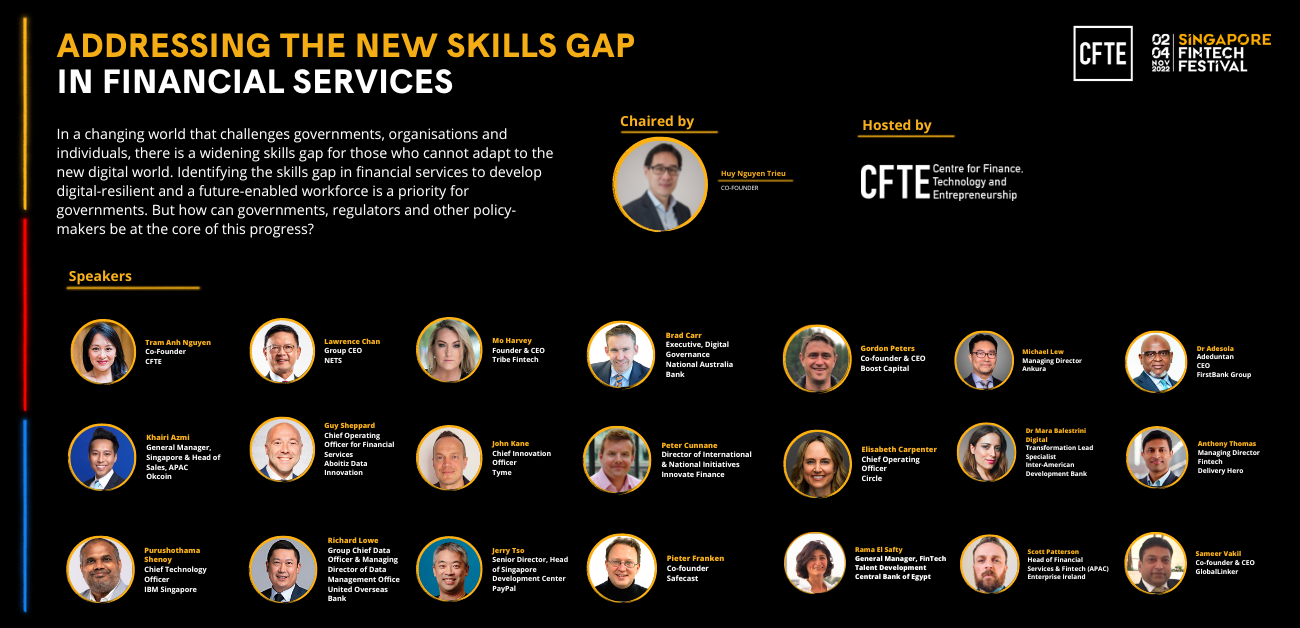
On 2 November 2022, CFTE brought together leaders from financial institutions, fintech companies, regulators and international organisations at the Elevandi Insights Forum during Singapore FinTech Festival. Moderated by Huy Nguyen Trieu, the roundtable examined how digital transformation was changing the capabilities needed to work and lead in financial services.

The discussion informed the New Skills in Financial Services report, published by CFTE and Elevandi on 7 December 2022. It explored the skills gap, the changing nature of financial careers and ways for individuals, organisations and governments to build a more resilient workforce.

Explore the key insights below and access the full report for the evidence, frameworks and recommendations.
The following insights are drawn from the CFTE and Elevandi report informed by this roundtable.

1. A wider range of skills is becoming essential

Digital transformation is changing both financial services jobs and the capabilities needed to perform them. The report uses CFTE's SHIME framework to consider five dimensions: soft skills, hard skills, industry knowledge, mindset and experience.

2. Transferable skills matter as roles evolve

Professionals need capabilities that remain useful as technologies, business models and job requirements change. Skills development cannot be limited to training for today's job description.

3. Industry knowledge and human capabilities complement technical skills

Understanding developments in financial technology, payments, digital assets and regulation matters alongside adaptability, collaboration and a willingness to learn.

4. Closing the gap is a shared responsibility

Individuals need to invest in their own capabilities, organisations need sustained workforce-development plans, and policymakers can support accessible education at scale.

5. Long-term learning systems are needed

Upskilling and reskilling require sustained strategies, alignment between stakeholders and practical implementation rather than isolated training interventions.

Explore CFTE at Singapore FinTech Festival 2026

All CFTE engagements, the team in Singapore and partner discount passes for SFF 2026 week, in one place.

Visit the CFTE SFF 2026 hub

What would you like to explore?

Speak with us about institutional AI readiness, leadership capability and workforce transformation. Share your organisation, discussion topic and preferred availability during Black Swan Summit Cambodia.

CFTE
Singapore FinTech Festival 2026

UK-Singapore AI in Finance: What Comes Next?

Date
Thursday 19 November 2026
Time
09:00 to 11:00 SGT, discussion from 09:30
Format
Invitation-led roundtable
Venue
Hogan Lovells Cadwalader, OUE Bayfront, Singapore

Singapore Fintech Festival 2022

On 2 November 2022, CFTE brought together leaders from financial institutions, fintech companies, regulators and international organisations at the Elevandi Insights Forum during Singapore FinTech Festival. Moderated by Huy Nguyen Trieu, the roundtable examined how digital transformation was changing the capabilities needed to work and lead in financial services.

The discussion informed the New Skills in Financial Services report, published by CFTE and Elevandi on 7 December 2022. It explored the skills gap, the changing nature of financial careers and ways for individuals, organisations and governments to build a more resilient workforce.

Explore the key insights below and access the full report for the evidence, frameworks and recommendations.

The following insights are drawn from the CFTE and Elevandi report informed by this roundtable.

1. A wider range of skills is becoming essential

Digital transformation is changing both financial services jobs and the capabilities needed to perform them. The report uses CFTE's SHIME framework to consider five dimensions: soft skills, hard skills, industry knowledge, mindset and experience.

2. Transferable skills matter as roles evolve

Professionals need capabilities that remain useful as technologies, business models and job requirements change. Skills development cannot be limited to training for today's job description.

3. Industry knowledge and human capabilities complement technical skills

Understanding developments in financial technology, payments, digital assets and regulation matters alongside adaptability, collaboration and a willingness to learn.

4. Closing the gap is a shared responsibility

Individuals need to invest in their own capabilities, organisations need sustained workforce-development plans, and policymakers can support accessible education at scale.

5. Long-term learning systems are needed

Upskilling and reskilling require sustained strategies, alignment between stakeholders and practical implementation rather than isolated training interventions.

Explore CFTE at Singapore FinTech Festival 2026

All CFTE engagements, the team in Singapore and partner discount passes for SFF 2026 week, in one place.

Visit the CFTE SFF 2026 hub
CFTE
Singapore FinTech Festival 2026

UK Pavilion: AI Innovation in Financial Services

How does the UK support financial innovation, and what do real innovators learn when they take AI to regulated buyers?

Status
Planned, subject to confirmation
Date and time
To be confirmed, SFF week
Format
Pavilion discussion with FCA colleagues and UK innovators
Venue
UK Pavilion, Singapore EXPO

Building on CFTE's collaboration with the FCA through the Supercharged Academy and the AI Spotlight Observatory.

The discussion

A UK-Singapore conversation grounded in what innovators have actually built and tested.

AI Innovation in Financial Services

Date and time to be confirmed · SFF week, 18 to 20 November 2026
UK Pavilion, Singapore EXPO (exact space to be confirmed)
Planned discussion with FCA colleagues and UK fintech innovators
CFTE co-founders Huy Nguyen Trieu and Tram Anh Nguyen, with participants to be confirmed

At the UK Pavilion during Singapore FinTech Festival 2026, CFTE is planning a discussion with the FCA and UK fintech innovators on how the UK supports financial innovation. Building on CFTE's collaboration with the FCA through the Supercharged Academy and the AI Spotlight Observatory, the session would showcase initiatives such as the Supercharged Sandbox alongside practical experiences from UK innovators, highlighting opportunities for collaboration between the UK and Singapore financial ecosystems.

Date, time, speakers and participating firms will be added as soon as the Pavilion organisers confirm them.

This session is a proposal until the Pavilion organisers confirm the slot and participants.

How the UK supports AI innovation

Four initiatives with complementary but distinct functions.

Supercharged Sandbox
Helps participating firms experiment with advanced AI in a controlled environment.
Supercharged Academy
Developed with CFTE to build institutional and regulatory fluency among founders.
AI Spotlight
Showcases innovation and makes relevant AI solutions visible.
AI Spotlight Observatory
Provides a taxonomy and an evidence-led way to explore AI use cases in financial services.

The October 2026 UK-Singapore Financial Dialogue joint statement records progress under the AI in Finance Partnership, including these initiatives. It is wider context for this session, not an endorsement of it.

What the session would cover

An illustrative flow, subject to the final format agreed with the organisers.

01

The business problem

Responsible AI innovation in finance needs technology, credible evidence, institutional understanding and routes to adoption, and many firms struggle to explain their product in terms a regulated buyer can evaluate.

02

The supporting ecosystem

A concise view of how experimentation, founder capability, visibility and shared evidence fit together, without implying that taking part in any initiative is an FCA endorsement.

03

Two UK innovators

What they built, how they tested it, what evidence a financial institution asked for, what they changed in response and what they learned about operating across markets.

04

Useful next steps

Where participants can learn more, connect with the firms directly, or talk to CFTE about the capability-building side of AI adoption.

Who should attend

For anyone interested in UK-Singapore collaboration on responsible AI in finance.

Financial institutions
Teams looking at innovators and AI solutions from the UK.
Innovators
Founders interested in how others took AI to regulated buyers.
Ecosystem partners
Organisations supporting UK-Singapore links in financial services.
Industry decision-makers
Visitors to the UK Pavilion working on innovation and adoption.

Meet CFTE at the UK Pavilion

Separately from this planned session, CFTE will be at its booth in the UK Pavilion throughout Friday 20 November to discuss capability diagnostics, AI leadership and AI Chief of Staff. Stand details will follow.

Explore CFTE at Singapore FinTech Festival 2026

All CFTE engagements, the team in Singapore and partner discount passes for SFF 2026 week, in one place.

Visit the CFTE SFF 2026 hub
Singapore Fintech Festival 2022

Addressing the New Skills Gap in Financial Services Roundtable

Date
November 2, 2022
Venue
Singapore Fintech Festival, Singapore EXPO
Format
In-person Elevandi roundtable at Singapore Fintech Festival

Event thumbnail

About this event

On 2 November 2022, CFTE brought together leaders from financial institutions, fintech companies, regulators and international organisations at the Elevandi Insights Forum during Singapore FinTech Festival. Moderated by Huy Nguyen Trieu, the roundtable examined how digital transformation was changing the capabilities needed to work and lead in financial services.

The discussion informed the New Skills in Financial Services report, published by CFTE and Elevandi on 7 December 2022. It explored the skills gap, the changing nature of financial careers and ways for individuals, organisations and governments to build a more resilient workforce.

Explore the key insights below and access the full report for the evidence, frameworks and recommendations.

Event photo

Key Themes

The following insights are drawn from the CFTE and Elevandi report informed by this roundtable.

1. A wider range of skills is becoming essential

Digital transformation is changing both financial services jobs and the capabilities needed to perform them. The report uses CFTE's SHIME framework to consider five dimensions: soft skills, hard skills, industry knowledge, mindset and experience.

2. Transferable skills matter as roles evolve

Professionals need capabilities that remain useful as technologies, business models and job requirements change. Skills development cannot be limited to training for today's job description.

3. Industry knowledge and human capabilities complement technical skills

Understanding developments in financial technology, payments, digital assets and regulation matters alongside adaptability, collaboration and a willingness to learn.

4. Closing the gap is a shared responsibility

Individuals need to invest in their own capabilities, organisations need sustained workforce-development plans, and policymakers can support accessible education at scale.

5. Long-term learning systems are needed

Upskilling and reskilling require sustained strategies, alignment between stakeholders and practical implementation rather than isolated training interventions.