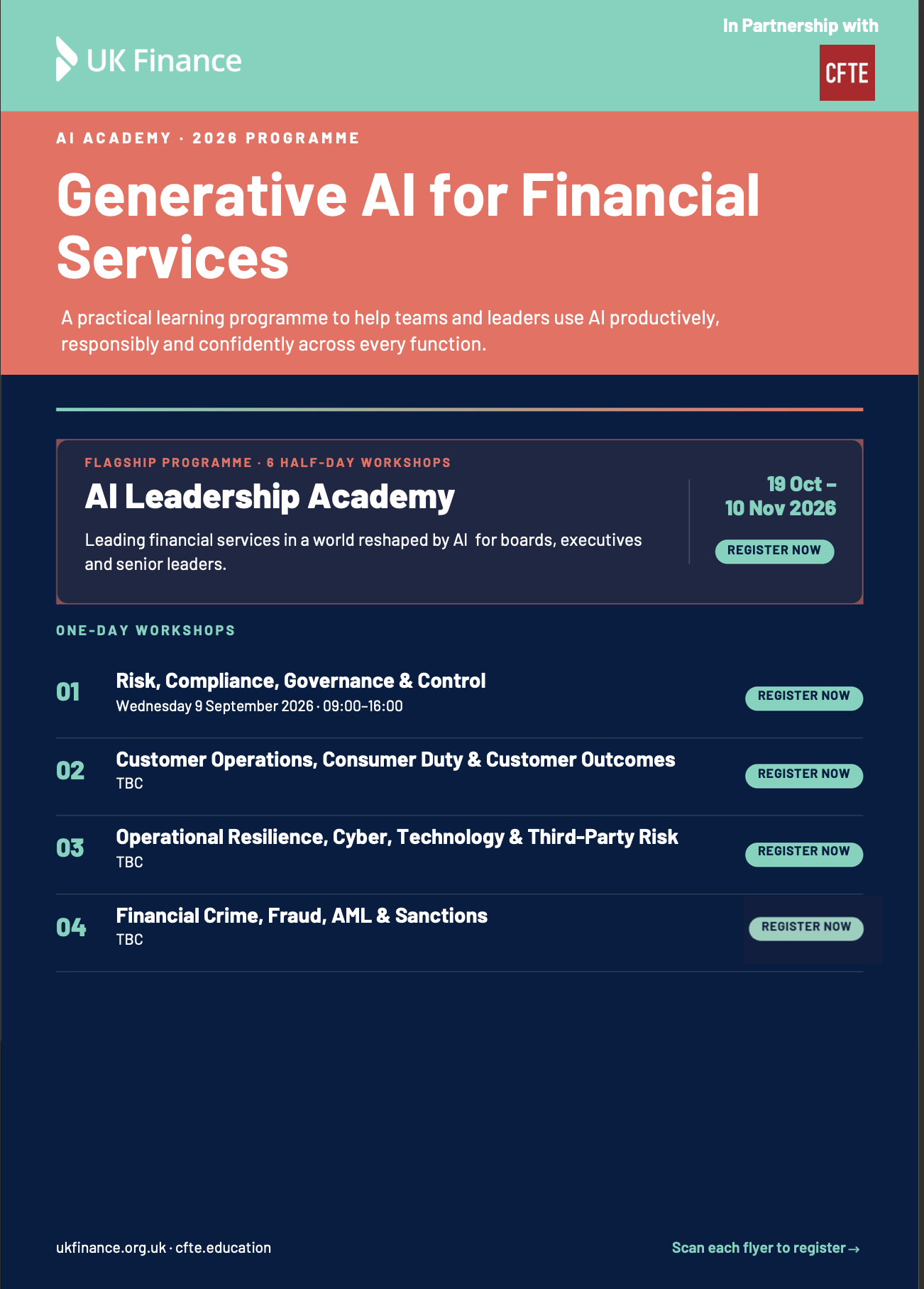
AI is changing how customer facing work gets done. Learn how to use it productively, responsibly and confidently.

Speed is not the measure in customer facing work. A response can be quick and still mislead a customer, miss a sign of vulnerability or blur the line between guidance and advice. Weak AI use produces inconsistent handling and thin evidence.
The workshop shows where AI speeds up preparation, and where the outcome decision stays with you.
A faster response that reaches the wrong outcome is not an efficiency gain. It is a Consumer Duty problem arriving sooner.
On completion, participants will be able to apply the following to work they already perform.
Turn fragmented interaction history into a summary the next colleague can act on immediately.
Assemble the facts and timeline, then surface what is not yet documented.
Produce clearer first drafts, more consistent in tone, with human judgement applied to fairness and clarity.
Surface indicators for review across a case history. The judgement remains with the professional.
Identify recurring themes across interaction volumes and convert transcripts into structured follow up checklists.
Session by session, with timings.
Built for the roles below — if you don't see yours listed, get in touch and we can help you check fit.
Also relevant for colleagues from risk, compliance, technology, data, transformation, audit, governance or business teams.
Confirm your place with the CFTE team.
Grounded in real world examples from financial services and regulated work, then translated into practical workflow exercises relevant to the role of each participant.
Prepare handovers and case summaries, structure complaint information and identify missing evidence before a decision is drafted.
The outcome decision and the fairness judgement remain human owned.
Organise case information and highlight potential vulnerability or escalation signals for human review.
AI must not replace human judgement, customer care responsibility or Consumer Duty accountability.
Draft customer communications more clearly, and review service quality themes across interactions.
Tone, clarity, fair treatment and the guidance versus advice boundary remain with accountable professionals.
A structured, one-day session that moves from context to hands-on practice, closing with a one page action brief for your sponsor.
| Time | Session | What happens |
|---|---|---|
| 09:00 to 10:00 | The AI shift and your role in it | What is changing with AI, and how customer facing professionals can contribute to AI readiness. |
| 10:00 to 11:30 | How AI is transforming this function | Use case areas across handovers, complaints, vulnerability support and customer communications. |
| 11:30 to 11:45 | Break | |
| 11:45 to 12:30 | Risks, limits and responsibilities | Risks, red lines, evidence requirements, human owned decisions and responsible use principles for customer facing work. |
| 12:30 to 13:30 | Lunch | |
| 13:30 to 14:30 | AI in action: from work to capability | How AI supports familiar work by improving preparation, synthesis, drafting, review, challenge and communication. |
| 14:30 to 15:30 | Workflow Application Lab | Peer groups work on a recurring customer facing task or workflow and explore how AI could improve it. |
| 15:30 to 16:00 | AI Readiness Action Brief | One workflow, one AI opportunity, one productivity or quality benefit, one control question and one next conversation. |
Facilitator and speaker details are to be confirmed.
Places are allocated by UK Finance member firm.
The programme converts into a one page output that can be presented to a manager or internal sponsor. The example below is illustrative.
| AI Readiness Action Brief | Illustrative example |
|---|---|
| Workflow to improve | Preparing a first pass complaint summary from customer interaction history. |
| Current pain point | Case information sits across notes, calls and correspondence, so handlers rebuild the picture first. |
| AI opportunity | Use an approved tool to summarise the history, structure the timeline and identify missing evidence. |
| Productivity benefit | Faster preparation, more consistent case handling and clearer evidence gaps before the outcome decision. |
| Control question | Which customer data may be used, how are outputs checked, and who owns the outcome? |
| Next conversation | Agree with the complaints or conduct lead a controlled test on anonymised historical cases. |
How AI capabilities apply to the tasks your function performs.
What AI can support, and what a human must own.
One recurring task or workflow that AI could improve.
A one page output to take to your sponsor.
This programme does not claim that AI can own accountable decisions. The following remain the responsibility of accountable professionals at all times.
UK Finance owns the initiative. CFTE is the specialist learning and delivery partner.

UK Finance is the collective voice for the banking and finance industry in the UK. This programme forms part of the UK Finance AI Workshop Series, a UK Finance initiative delivered in collaboration with CFTE.
Visit ukfinance.org.uk →Practical detail
UK Finance owns the initiative. CFTE is the specialist learning and delivery partner, and designs and facilitates the sessions.
Yes. The functional workshops are scoped to different functions and run on different dates, so institutions commonly send different people to each. The Related programmes section on this page lists the others in the series.
The Participant outputs section on this page lists what you leave with. The central output is a completed brief on your own work, written during the day rather than promised for afterwards, which is why participants are asked to bring a real process or decision to work on.
Yes, and most participants attend with employer support. The Request sponsorship button opens a pre-written email you can send to your own manager. It carries a link back to this page so they can see the scope, the date and what you will bring back.
Use the Register for the workshop button on this page. It opens a pre-written email to UK Finance, who own the initiative and handle enrolment. If you would rather write your own, the contact is Robert Moss at UK Finance.
One day, delivered live online, run as a facilitated working session rather than a lecture. The Agenda section on this page sets out the running order, including the points where participants work on their own material.
No. There is no coding and no model building. The day assumes you know your own function well and treats AI as a tool applied to work you already understand.
The workshops are built for the people who do the work rather than the people who supervise it. Each day is scoped to a single function, so the room is made up of practitioners, team leads and managers from that function, together with the risk, compliance and technology colleagues who sit alongside them. The Who should attend section on this page lists the specific roles for this workshop.