
Across organisations, some people are using AI to complete existing tasks faster. Others are using the same technology to redesign how the work itself happens, building systems, workflows and agents that can affect hundreds or thousands of people.
That difference is the subject of CFTE's new whitepaper, The AI-fication of System Thinking.
AI productivity and AI system leverage are not the same thing. One compresses the time a task takes. The other changes which tasks exist at all.
When the ability to build becomes widely available, who will know what should be built, how the parts should work together, and where human judgement must remain?
In May 2025, The AI-fication of Talents identified a hidden trend. System Thinkers were acquiring extraordinary new leverage because AI was collapsing the distance between an idea and its implementation. Cursor was one of the clearest early signals: a small team built a company that reached a scale which historically required far more people, capital and time.
Thirteen months later, the phenomenon is much easier to see.
Small AI-native teams are producing outcomes that used to require a full organisation behind them.
Professionals inside established organisations can increasingly build systems that previously required a formal technology project.
Experts are beginning to turn their methods and judgement into executable AI capabilities that thousands of other people can use.
Citi is building infrastructure for AI agents. Morgan Stanley has deployed AI tooling across large parts of its engineering organisation. The UAE is moving towards agentic AI across federal government.
It is the combination of two distinct capabilities. Neither one is sufficient on its own.
The ability to make sense of complexity, identify the real outcome, see the underlying structure and redesign the system rather than simply work harder inside it.
The ability to understand what AI can do, represent work and knowledge so machines can operate on it, build workflows and agents, and verify that the resulting system works reliably.
They create a new type of professional: someone who can see the system and build it.
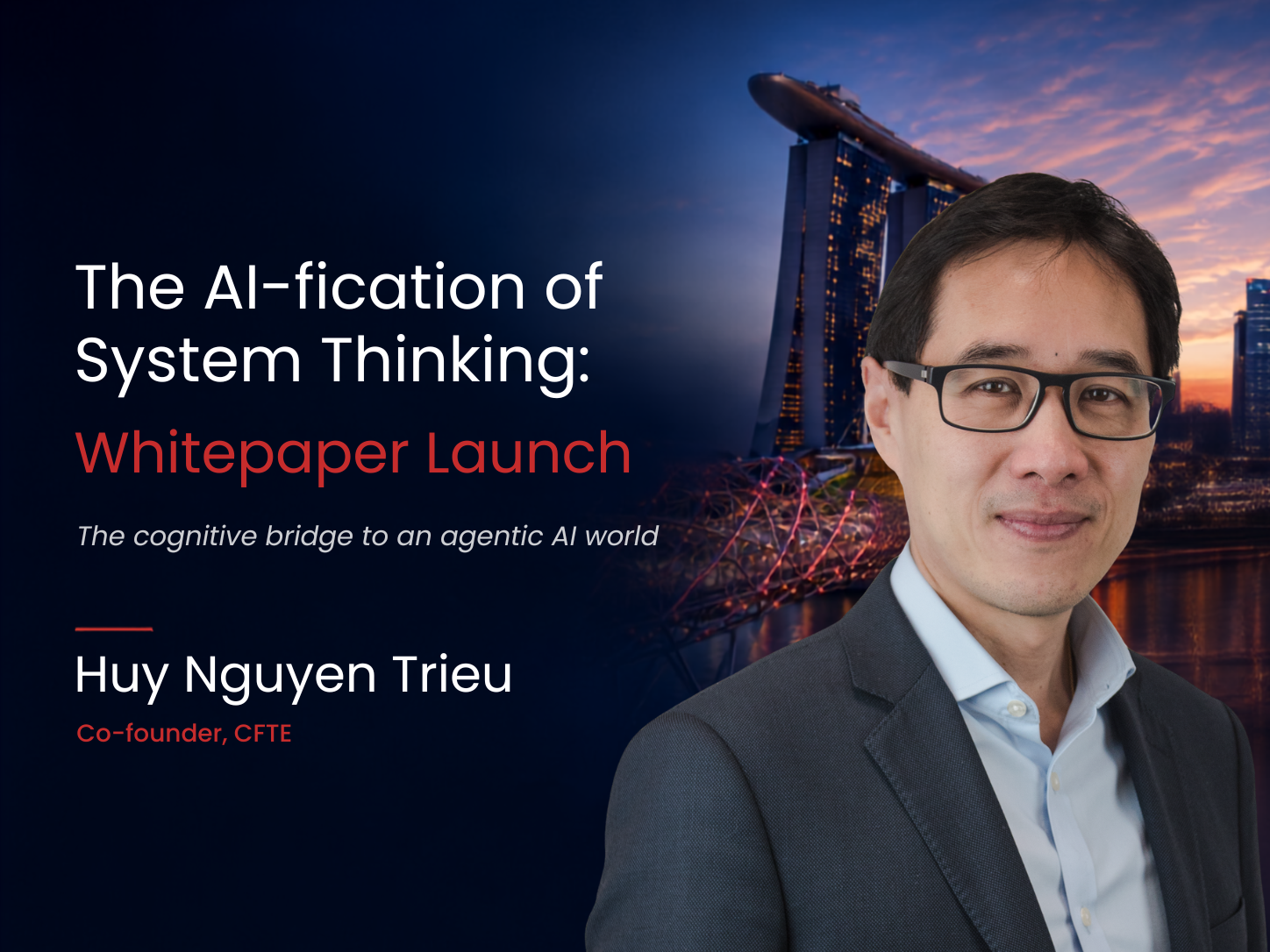
Huy Nguyen Trieu works through what the paper means for individuals, organisations and policymakers.
Why AI productivity and AI system leverage are fundamentally different
How the hidden trend has materialised since 2025
The four emerging profiles: Everyday Professionals, Tinkerers, Theorists and AI System Thinkers
Why AI capability without System Thinking can create as much risk as value
How much System Thinking different people actually need
How organisations can identify and develop AI System Thinkers at scale
Co-founder, CFTE. Presents the paper, the difference between using AI to work faster and using it to redesign how the work happens, and what AI System Thinking means for institutions and policymakers.
The paper is written for the people who decide what gets built, not only for the people who build it.
Transformation and change leaders
Regulators, central banks and government
Heads of workforce development and talent
Operating and business line leaders
Strategy and innovation teams
Leaders assessing agentic AI
A printed copy of the paper, and the four profiles as a way to read the AI capability already sitting inside your own organisation.
Presentation, panel and open questions, 18:00 to 20:00, followed by networking.